
The Parliament of the Balearic Islands gives the green light to the creation of the University of Mallorca (UMAC)

>> Its main objective is to offer new undergraduate, master’s and doctoral degrees in strategic sectors, in high demand and, for the most part, currently unavailable in our islands. >> The University of Mallorca has a network of campuses distributed throughout Mallorca (in Inca and Palma) to bring higher education closer to society. >> UMAC was also born with a strong research vocation and an international orientation, integrating innovative methodologies, academic collaboration with prestigious universities and training connected with current scientific and professional challenges. The Parliament of the Balearic Islands has today approved the Law creating the University of Mallorca, which is born with the objective of expanding the educational offer, adapting it to new professional demands and bringing higher education closer to the whole of the island through a network of campuses distributed in different points of Mallorca (Inca and Palma Son Rossinyol-Coll d’en Rabassa-Jaime III), while strengthening the capacity of the territory to generate knowledge, innovation and opportunities. The new university is part of an academic project aimed at adding capabilities to the existing system, incorporating new degrees in strategic areas and making it easier for more students to pursue their higher education in the Balearic Islands. In this context, the project is based on ADEMA’s solid track record, which boasts over 30 years of experience in higher education, research, and educational innovation in the Balearic Islands. This experience has allowed it to consolidate a firm academic foundation, establish a fully operational structure, and maintain close ties with the islands’ social and economic fabric through collaboration with more than 400 companies and its active presence in various socioeconomic institutions across the archipelago. New academic offerings focused on strategic sectors The University of Mallorca aims to prevent the brain drain of Balearic talent, attract national and international profiles and contribute to a greater balance of the Balearic university system, aligning its educational offering with the real needs of the economic and social environment. The new institution will deploy a broad, specialized and strategic academic offering, designed to respond to areas with high training and professional demand, and to expand opportunities for access to higher education in the Balearic Islands. In the field of Health Sciences, the initial offerings will include degrees in Biomedicine, Biomedical and Health Engineering, Medicine, Speech Therapy, Human Nutrition and Dietetics, and Dentistry (the latter also taught in English). Master’s degrees in Oral Surgery and Implantology, Oral Health Engineering, Clinical Nutrition, and Digital Dentistry (also taught in English) will also be offered, along with a doctoral program in Health Sciences. Alongside this area, a second academic track will be established, focusing on Architecture, Arts, Design, Social Sciences, Technology, and Management. Within this framework, undergraduate degrees will be offered in Architecture, Fine Arts, Political Science and Public Administration, Sports Business Management, Design, Video Game Design, Data Engineering, Sociology, Sociology and Data Engineering, and Sports Business Management. This offering will be complemented by master’s degrees in Architecture (professional qualification), Professional Development in Fine Arts, and Product Design, as well as a doctoral program in Art, Design, and Humanities. In addition, a Continuing Education program will be developed to meet the training needs of our Islands. An interdisciplinary, practical academic model connected to reality One of the central pillars of the University of Mallorca is its academic model, based on interdisciplinarity, the practical application of knowledge and direct connection with the professional and socio-economic environment. The training will combine theoretical teaching with project-based and service-based learning, integration of cutting-edge technologies and 3D simulation environments, allowing students to prepare for complex and constantly evolving professional contexts. This approach incorporates tools such as artificial intelligence, clinical simulation, virtual environments and haptic 3D technologies, as well as active methodologies that place the student at the center of the learning process. Furthermore, the project is committed to a cross-cutting approach that connects disciplines such as health, design, technology and business, generating synergies that respond to new production and knowledge models. Teaching will take place in a multilingual environment, in Catalan, Spanish and English, which reinforces the international projection of the students, and a team of first-rate teachers, researchers and active professionals at the regional, national and international levels. Boosting research and knowledge generation The University of Mallorca incorporates a clear research vocation, oriented both towards scientific production and the transfer of knowledge to society and the productive fabric. This line of research is based on an already consolidated research trajectory, with growth in scientific publications, development of patents and work in advanced areas such as health, nutrition or applied artificial intelligence. Furthermore, the project envisions close collaboration with international universities and research centers, which will allow the new center to be integrated into global academic networks and promote the mobility of students and researchers. A territorial model that brings the University closer to society The new academic institution boasts a network of campuses spread across Mallorca, with locations in Inca and Palma (Son Rossinyol, Coll d’en Rabassa, Jaime III), as well as an online campus. Its aim is to bring higher education closer to the community, strengthen the region’s infrastructure, and revitalize diverse urban areas. The project combines sustainability and efficiency by renovating existing spaces and incorporating specialized infrastructure for teaching, research, innovation, advanced clinical practice, and knowledge transfer in strategic areas such as health, architecture, the arts, design, technology, and social sciences. This model strengthens the connection between the university and the productive sectors of the territory, facilitating knowledge transfer, applied innovation, and student employability. Furthermore, the project is based on sustainability and efficiency criteria, focusing on the reuse of existing spaces and a balanced development of the territory. Connection with the economic and social fabric It was born with a strong connection to the economic and social fabric of the Balearic Islands, relying on a broad network of collaboration with companies, institutions and entities from different sectors. This ecosystem, developed over 30 years of academic activity, allows training to be geared towards the real needs of the environment, promotes the
ADEMA brings together more than 20 leading international universities in Palma for its international research weeks in Nutrition, Dentistry and Fine Arts
>> Students and teaching staff will participate in different academic programs that address major contemporary challenges in Health Sciences and artistic creation ADEMA University School, committed to further developing its academic internationalization model, will hold its three major international weeks this coming April and May. This series of events will bring together professors, researchers, professionals, and students from leading universities and centers in Europe and the United States in Palma, focusing on Nutrition, Dentistry, and Fine Arts. The program is structured around the 5th International Nutrition Week, from April 20 to 24, the 8th International Dental Week, from May 11 to 15, and the 5th International Art Week Congress, on May 28 and 29. Beyond their nature as specialized events, these three gatherings form an academic ecosystem focused on knowledge transfer, scientific updates, and the building of international networks. V International Nutrition Week The 5th International Nutrition Week will kick off the calendar with a focus on contemporary challenges in human nutrition and dietetics, addressed from scientific, clinical, and technological perspectives. Over five days, the program will combine analysis of emerging trends, applied training, and reflection on the role of food in public health and sustainability. One of the main focuses will be the study of plant-based diets, both in the context of athletic performance and their implementation in clinical practice. The participation of specialists affiliated with the Spanish Academy of Nutrition and Dietetics will allow this issue to be addressed using the most recent scientific evidence, while the university faculty involved will contribute tools for its application in clinical practice. The week will also include a specific session dedicated to gut health, a rapidly growing field within clinical nutrition, which will analyze the role of supplementation in digestive balance and personalized dietary interventions. This practical approach will be complemented by a session focused on obesity, addressing dietary strategies from the perspective of research and product development, with the participation of experts from technology centers such as the National Center for Food Technology and Safety. The technological dimension of nutrition will play a prominent role through the participation of EURECAT, which will present European projects aimed at improving food safety by identifying emerging contaminants and developing innovative solutions for the food industry. This approach positions Nutrition Week at the intersection of science, technology, and food production. The program will conclude with a specialized session on clinical nutrition applied to chronic kidney disease, taught by professors from the University of Lisbon, which reinforces the international dimension of the meeting and its orientation towards intervention in complex pathologies. VIII International Dental Week The 8th International Dental Week, the second major event on the calendar, will delve into the technological and clinical transformation of modern dentistry. For five days, Palma will become a hub for academic exchange, bringing together specialists from international universities such as the University of Pennsylvania, the Academic Centre for Dentistry Amsterdam, the University of Georgia, the University of Oslo, the University of Lublin, the University of Turin, and the University of Barcelona, along with leading companies from key industries in the sector, including Straumann, Klockner, FKG, and Ultradent, among others. The program is characterized by a strong focus on innovation, with content centered on digital dentistry, artificial intelligence applied to diagnosis, advanced clinical simulation, and the integration of new technologies into clinical practice. From day one, with workshops on biomaterials in pediatric dentistry and sessions on digital dentistry, a framework is established in which technology is presented as the driving force behind the transformation of the discipline. Throughout the week, key topics such as teeth whitening, ceramic restorations, adhesion to dental tissues, and the use of diode lasers will be addressed, combining scientific updates with clinical application. The presence of international experts will allow for the analysis of these advances from different academic and healthcare perspectives, enriching the approach of the meeting. The program also incorporates a public health dimension through sessions on oral epidemiology and the prevention of oral diseases, as well as an advanced clinical approach with content on microendodontics, implantology, ultrasound, and ultrasonography applied to dentistry. This thematic diversity reflects the current complexity of the discipline and its evolution toward more technological and specialized models. One of the distinguishing features of Dental Week is its focus on practical training. Hands-on workshops, live demonstrations, and competitions with haptic simulators allow learning to be transferred to realistic simulation environments, bringing students closer to complex clinical situations. In addition, there is active student participation through scientific presentations, as well as sessions focused on international employability, connecting university education with the global job market. V International Art Week Congress The 5th International Art Week Congress will close the cycle with a focus on higher education in Fine Arts as a space for research, innovation, and critical reflection. Unlike the other events, this congress is situated within the realm of artistic research and pedagogy, addressing the role of art in a context marked by technological transformation, the creative economy, and the redefinition of career paths. One of the most significant aspects of this edition will be the presence of more than twenty leading international universities and centers. These include Chelsea College of Arts at the University of the Arts London, the Royal Danish Academy, the Accademia di Belle Arti di Brera, the Aarhus School of Architecture, Princeton University, Zurich University of the Arts, the University of Applied Arts Vienna, Aalto University of Finland, IUAV Università Iuav di Venezia, and the Sint Lucas School of Arts in Belgium, among others. The participation of these centers will bring together academic profiles linked to artistic research, architecture, cultural economics, curatorial practice, art theory, and the intersection of art, science, and technology. This diversity reinforces the interdisciplinary nature of the event and its capacity to foster dialogue between different approaches to artistic expression. The program on May 28 at the Barceló Foundation will combine workshops, the official opening, and the inaugural lecture, along with the presentation of a joint exhibition between ADEMA and the
ADEMA is promoting a research center and the development of international Master’s degrees in Dentistry at Jaime III.
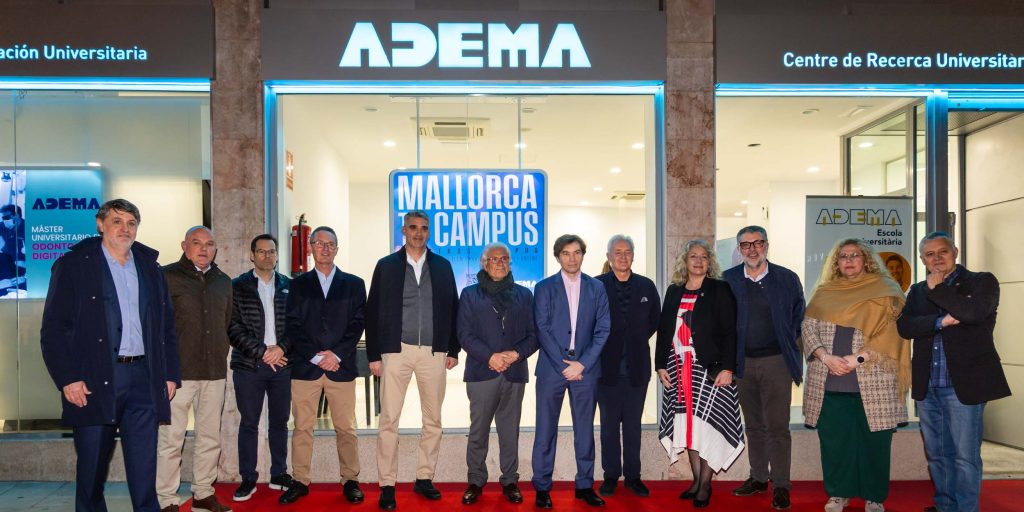
>> The Higher Education and University entity, with more than 30 years of experience, presented this afternoon the new innovative center to public institutions, socio-economic entities, collaborating companies, as well as to more than 30 NGOs and Welfare areas of 15 Municipalities of Mallorca. >> It aims to create an innovative university hub with international teachers and researchers in Dentistry and Human Nutrition, in its commitment to knowledge transfer and the diversification of the Balearic economy. >> It will have an information point to guide prospective students on the training offer and the access processes. >> ADEMA has several open lines of research with clinical application of the most advanced dental techniques of today in artificial intelligence, 3D haptic simulation, digital workflow, radiology or guided implantation. ADEMA presented this afternoon in Palma the new Centre d’Investigació Universitària de Mallorca, a strategic space, in the heart of Palma, on Jaime III Avenue, which integrates research, postgraduate training, doctorate, advanced clinical practice and knowledge transfer in Dentistry and Human Nutrition and Dietetics. The center aims to become a magnet for top-level research talent and consolidate itself as a national and international inter-university hub as a commitment to diversifying the Balearic economy. ADEMA, with more than 30 years of experience in official Higher Education and university qualifications and a strong social commitment, this afternoon showcased the new facilities of its Research Center in an event attended by representatives of public institutions, socio-economic entities and healthcare companies, as well as more than 30 NGOs and representatives from the Social Welfare departments of 15 municipalities in Mallorca. The new facility, with an approximate area of 450 square meters, has been designed to bring together specialized teaching, scientific activity, and direct connection with professional practice in a single environment. Its opening is part of ADEMA’s strategy to develop academic infrastructure, strengthening its specialization and excellence in teaching and research in Health Sciences and contributing to the economic diversification of Mallorca. In addition, it will have an information point to guide prospective students on the training offer and the access processes. The center was founded with the aim of becoming a permanent meeting point for researchers, faculty, healthcare professionals, and students, fostering collaborative work and the creation of synergies. Its model is bidirectional: clinical activity generates new scientific questions, and, in turn, research results are incorporated into clinical protocols, advanced training, and professional practice. In the area of education, the new University Research Center of Mallorca will host the practical activities of specialized Master’s programs in Dentistry, taught by international faculty. Among its key strategic initiatives is the Master’s in Digital Dentistry, one of the most innovative programs in advanced dental training. This postgraduate program focuses on the comprehensive mastery of digital workflows applied to the diagnosis, planning, and execution of treatments. It incorporates cutting-edge technologies such as artificial intelligence applied to diagnosis and treatment planning, virtual simulation systems and haptic training, magnification devices, ultrasound scanners, clinical microscopy, dental lasers, digital occlusal analysis systems, and CAD/CAM technology, all aimed at optimizing minimally invasive procedures. Among the main lines of research currently being pursued by ADEMA, the early detection of oral cancer using artificial intelligence stands out. The center is analyzing radiographic, ultrasound, and photographic images to develop algorithms capable of identifying lesions in their early stages. This line of research is complemented by the study of salivary biomarkers as a non-invasive diagnostic tool, which could facilitate more accessible and accurate screening systems. Artificial intelligence applied to healthcare is another strategic focus. ADEMA is researching the use of neural networks for the early detection of diseases, the development of algorithms for predicting dental treatments, and the creation of 3D virtual reality software for medical and surgical simulations. Advanced medical simulation is another key area of focus. They are developing 3D haptic and holographic technologies for surgery, diagnostic and exploratory techniques, and anesthesia, as well as devices that improve precision in dental implantology. These tools enable high-fidelity training and optimize surgical planning before operating on the patient. They are also collaborating with the Health Living Lab at Son Espases University Hospital on a haptic (tactile) simulation project to address colorectal cancer and apply it to other surgical specialties in the future. Furthermore, it participates in European projects focused on designing new learning methodologies based on haptic and holographic simulation, the initial results of which have already been published in high-impact scientific journals. The center also investigates the integration of immersive environments for advanced teaching in the Health Sciences. Internationally, ADEMA is participating in a Phase III clinical trial for the development of a dental drug, in collaboration with university and hospital centers in the United States and the European Union. This project involves dentists, physicians, pharmacists, chemists, engineers, and other healthcare professionals from various centers in the Balearic Islands, consolidating a multidisciplinary scientific network with a global reach. Research in Human Nutrition and Dietetics is another strategic area. Projects are developed aimed at generating scientific evidence applicable to the prevention and management of prevalent diseases. Among the research projects, the AOX project on antioxidant diets and their impact on the body stands out, along with studies on intermittent fasting and physical activity, and analyses of the effect of the Mediterranean diet on the prevention of chronic diseases such as diabetes, obesity, and cardiovascular disease. Public health studies are also being conducted with direct applications in preventative programs and improvements to the quality of care. Knowledge transfer to society and industry is another priority. The research developed at ADEMA has direct applications in medical treatments, new healthcare technologies, and the creation of startups and patents. Among the most notable examples are patents for medical accessories developed during the COVID-19 crisis, such as custom-fit devices for face masks and protective face shields with laminar airflow. A haptic 3D positioning device for dental implant surgery and a pioneering oral splint that facilitates intraoral ultrasound scans using ultrasound, improving diagnostic accuracy and patient comfort, have also been patented. The new Jaime III