
The Royal Academy of Medicine of the Balearic Islands (RAMIB) awards three prizes to ADEMA and recognises the work of 13 researchers for their studies in the field of Health Sciences
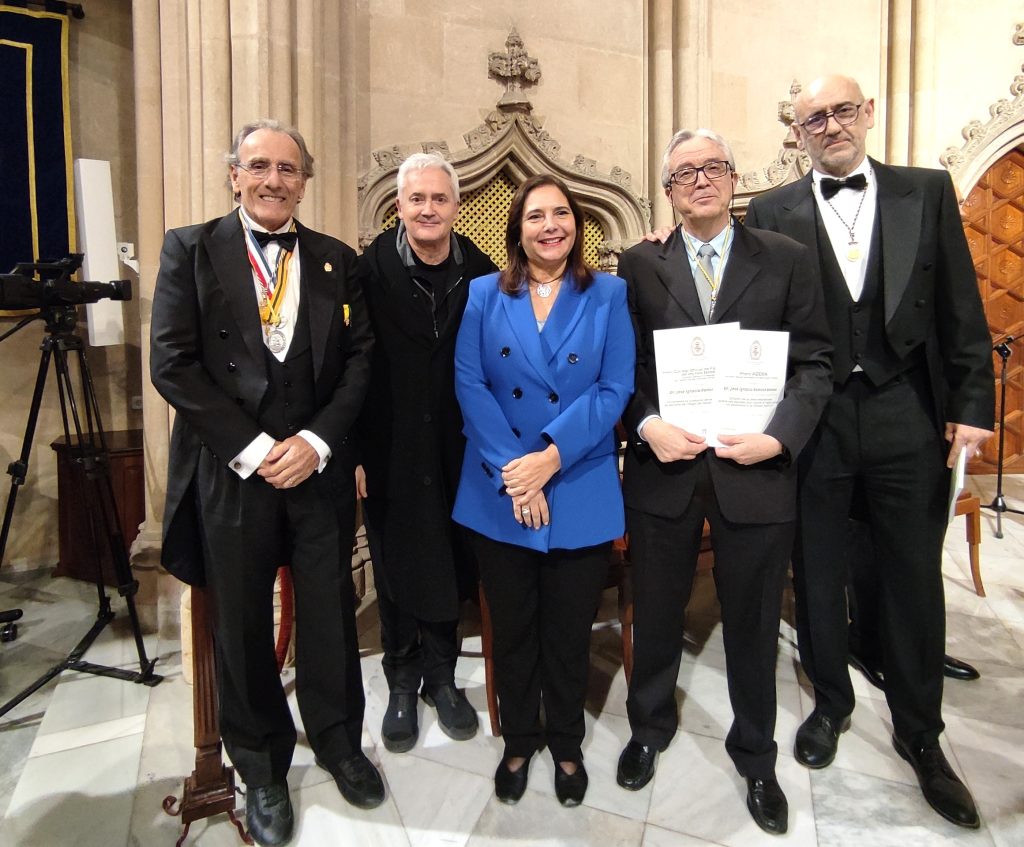
>> The awards recognise and reinforce the work being carried out by the team of researchers, committed to R&D&I and to creating new spaces for technological and innovative development. Thirteen researchers from the ADEMA-UIB University School have been recognised by the Royal Academy of Medicine of the Balearic Islands (RAMIB) with three awards that highlight their excellence in research. These awards reflect the commitment of the ADEMA team to innovation, new technologies and knowledge transfer in the field of Health Sciences. Among the award-winning works is one led by doctors Raúl Cuesta Román, Javier Varona Gómez, Nora López Safont, Joan Obrador de Hevia, Hernán Paublini Oliveira and Emilio Martínez-Almoyna Rifà, who have received the Doctor Ramón Rotger Moner Award for the best study on surgery and surgical specialties with the title “Comparison of the mesial spatial deviation of a prototype during the placement of dental implants, validation through a preclinical study in a 3D haptic simulator”. Likewise, doctors José Ignacio Ramírez Manent, Ignacio Ramírez Gallegos, María Gordito Soler, Miguel Aguiló Juanola, Hilda González San Miguel, Marta Marina Arroyo and Katrina Riera Routon have been awarded the Prize of the Official College of Pharmacists of the Balearic Islands for their research entitled “Does statin consumption increase the values of insulin resistance risk scales?” Finally, the ADEMA Award for the best research study in oral health and nutrition has been awarded to the team made up of doctors José Ignacio Ramírez Manent, Lluis Antoni Rodas Cañellas, Sofia Montemayor Frías, Isabel Pilar Soler Pocoví, Pablo Estabala Alández and Alicia Julibert García for their work “Effect of the Mediterranean diet on the scales that assess non-alcoholic fatty liver disease and liver fibrosis”. The president of the ADEMA University School, Diego González, congratulated the winners and highlighted the recognition of the RAMIB for the work carried out by the academic centre’s researchers. “These awards are an example of the impact that our lines of research have, both at a scientific level and in improving people’s quality of life. At ADEMA we are committed to an educational model in which research is a backbone, and this type of award reinforces our mission to lead innovation in health sciences,” he argued. For his part, the president of the ADEMA Research Advisory Board, Dr. Pere Riutord, has underlined “the connection between teaching and research as a priority. We knew that in order to train the best professionals we needed to be directly involved in scientific advances. These awards not only endorse the quality of our projects, but also motivate our students and teachers to continue exploring new lines of knowledge.” Finally, the director of R&D+i at ADEMA, Dr. Arturo López, praised the institution’s human team’s ability to develop highly relevant projects. “Each of these awards represents the effort and dedication of a multidisciplinary group of researchers who work to offer tangible results that have a real impact on society and on the development of technology in the field of health,” he concluded.
The president of CODNIB, Manuel Moñino, motivates future dieticians-nutritionists by highlighting their role in the social environment and the wide variety of professional opportunities in Public Health and Primary Care

The president of the Official College of Dietitians-Nutritionists of the Balearic Islands (CODNIB), Manuel Moñino, has held a meeting with students of the Degree in Human Nutrition and Dietetics to explain the importance of this profession in various fields, highlighting how their skills can have a decisive influence on public policies, the development of Public Health campaigns and the improvement of Primary Care. Moñino has highlighted the crucial role of dieticians-nutritionists in promoting a healthier society and in solving current challenges related to food and health. In addition, he encouraged students to actively engage in all aspects of the profession, facing each challenge with curiosity, passion and a critical attitude, and stressed the need to continue learning and exploring the multiple areas of specialization that this discipline offers, from research and education to the clinical, community and business spheres. Manuel Moñino’s visit not only motivated the students, but also reinforced our center’s commitment to training competent professionals prepared for the future of nutrition.
Human Nutrition students from the ADEMA University School analyze the role of aquaculture in healthy diet and environmental sustainability

>>>First-year students have had the opportunity to immerse themselves in and get to know the facilities of Aquicultura Balear in depth. First-year students of the University Degree in Human Nutrition and Dietetics at the ADEMA University School have had the opportunity to further their training with a visit to the facilities of Aquicultura Balear, a hatchery belonging to the Cooke España Group. This company specialises in the breeding and marketing of two emblematic species of white fish in the Mediterranean diet: sea bream (Sparus aurata) and sea bass (Dicentrarchus labrax). During this experience, students were able to see first-hand the facilities and operation of the company’s different departments, including larval culture, weaning and pre-fattening of fish. Each stage of the production process was explained in detail by company representatives, who also stressed the importance of quality control at all stages, guaranteeing a final product that meets the highest food safety standards. Nutrition, a key pillar in aquaculture One of the highlights of the visit was the focus on the nutrition of aquaculture species. Experts from Aquicultura Balear explained how specific feed formulas are developed that combine both fish and vegetable flours and oils. These formulas are designed to offer a balanced diet rich in amino acids, essential fatty acids, vitamins and minerals, which not only favours the intestinal health of the fish, but also contributes to their growth and well-being. This care in feeding has a direct impact on the quality of the final product, ensuring its nutritional value for consumers. Furthermore, the role of aquaculture as a sustainable solution to the global demand for seafood was highlighted. Through responsible practices, this industry not only ensures the availability of high-quality food, but also contributes to the conservation of aquatic ecosystems. An educational activity with practical impact The visit is part of the academic plan of the subject General Biology, taught by the teacher and researcher Dr. Estefanía García Ruiz. Dr. García Ruiz explained that “this activity, developed under the project-based learning methodology, allowed students to connect the theoretical concepts learned in class with their practical application. This experience has given them a comprehensive view of the role of aquaculture in healthy diet and environmental sustainability. In addition, it has allowed them to value the importance of the balance between science, technology and conservation in the food sector. Promoting practical learning at ADEMA The ADEMA University School continues to support an educational model that combines quality academic training with practical experiences that prepare students for the challenges of the working world. Collaboration with leading companies, such as Aquicultura Balear, not only enriches student learning, but also strengthens the link between the university and the business community.