
The Rebellion of the Toys: The Transgressive Universe of Santos Iñurrieta Takes Over the ADEMA Campus in Inca
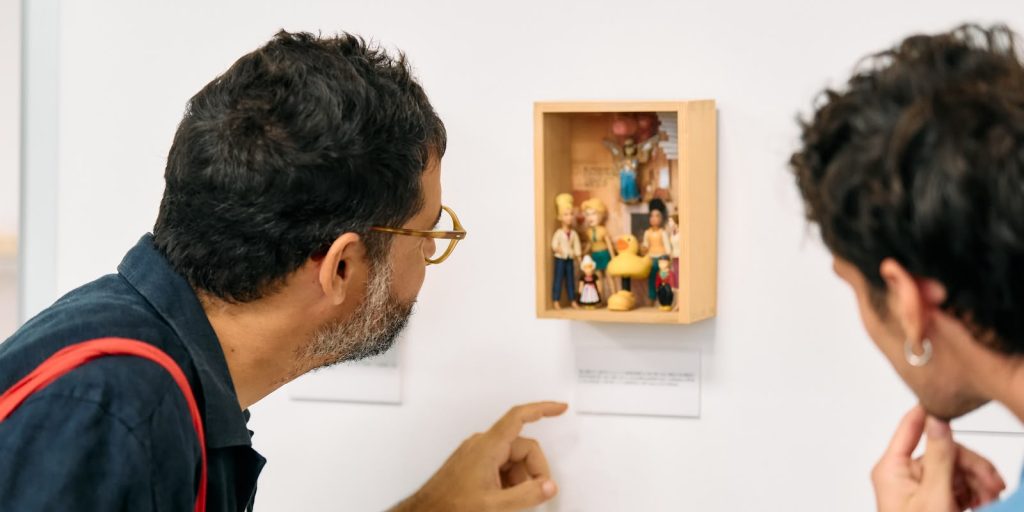
> The exhibition is part of the Mallorca International Comic Festival, CòmicNostrum 2026, and can be visited until December 18 at the ADEMA Campus Inca. > The exhibition “Kajika’s” brings together a collection of hybrid creatures created from toys and objects salvaged from flea markets. Palma, October 16, 2026 This afternoon, ADEMA Campus Inca inaugurated the exhibition “Kajika’s”—a unique showcase dedicated to one of the most surprising and personal facets of the artist Santos Iñurrieta (Vitoria, 1950 – Mallorca, 2023). Iñurrieta was a pivotal figure in the artistic and cultural scene of the Basque Country and maintained close ties to Mallorca, where he lived and pursued his creative work for over three decades. The exhibition—part of the CòmicNostrum 2026 International Comic Festival, held from October 14 to 18 in Inca and Palma—brings together a unique collection of small sculptures and three-dimensional assemblages crafted from dolls and objects found at flea markets. Through these pieces, Iñurrieta has constructed a universe of hybrid creatures—at once grotesque and tender—that blend dark humor and irreverence with a critical perspective on the contradictions of contemporary society. From the innocent toy to a critique of the adult world The “Kajika’s” originated within the private confines of the artist’s studio, where Iñurrieta found that manipulating and transforming toys served as a form of experimentation, amusement, and even personal therapy. Dismantled dolls, fragmented bodies, and seemingly unrelated elements took on new identities in the hands of their creator. The result is a gallery of absurd, deformed, and unruly beings that shed their original innocence to become unsettling characters—capable of eliciting both a smile and a moment of reflection. These small sculptures translate the artistic universe of Santos Iñurrieta—characterized by creative freedom, a transgressive spirit, and an irony that permeates much of his artistic output—into three dimensions. An artist, collector, and avid reader of comics since his youth, he maintained a close connection to the language of comics and alternative illustration. His paintings frequently incorporated characters and references drawn from this imaginative world. He also collaborated occasionally with the Basque satirical magazine TMEO and, in 2022, published a book of comics with the Majorcan publisher Autsaider Cómics. His participation in CòmicNostrum offers an opportunity to discover this facet of his career and to introduce the public to a body of work that brings together painting, sculpture, graphic humor, and artistic experimentation. A tribute to the creative freedom of Santos Iñurrieta During the opening, Joana Nicolau, the artist’s partner, highlighted the deeply personal nature of these creations and their ability to reflect the unique way in which the artist observed the world. “The ‘Kajikas’ reveal a very special side of Santos. They were a way for him to have fun, to experiment, and to express—with humor and irony—everything that reality stirred in him. Being able to share these pieces with the public now is also a way to keep his perspective and his extraordinary creative freedom alive,” noted Joana Nicolau. For his part, the president of ADEMA, Diego González, has underscored the importance of bringing the legacy of artists—who have developed their own unique languages and championed experimentation as an essential part of the creative process—closer to students and society at large. “Hosting an exhibition by Santos Iñurrieta is an opportunity to champion the value of artistic freedom, critical thinking, and the ability to transform everyday objects into new forms of expression. His work reminds us that creativity also stems from questioning the status quo and viewing reality from different perspectives,” he noted. Furthermore, González has highlighted ADEMA’s commitment to establishing its Inca campus as a space open to contemporary creation, cultural exchange, and the meeting of artists, professionals, and students. ADEMA, a meeting point for art, design, and comics The opening of “Kajika’s” is part of ADEMA Campus Inca’s participation in CòmicNostrum 2026, an event for which the university center once again serves as one of the host venues. The morning’s program featured a series of professional sessions aimed specifically at students of Design and Fine Arts, with contributions from Tomeu Morey, Puño, Marika Vila, Héloïse Guerrier, Emilio Bernárdez, Florentino Flórez, and Feliu Renom, who shared their knowledge and experience regarding illustration, comics, and graphic creation. Through this initiative, ADEMA reinforces its commitment to the dissemination of contemporary culture and to fostering connections between university education, artistic creation, and professionals in the field. The “Kajika’s” exhibition will remain open to the public until December 18th at ADEMA Campus Inca, located at Carrer del Tren, 72. It can be visited Monday through Friday, from 8:00 a.m. to 4:00 p.m.
The University of Mallorca and the University of Heidelberg are strengthening their scientific collaboration in medicine, biomedicine, and health engineering.

>>The agreement will make it possible to leverage the German university’s expertise in artificial intelligence applied to medicine, with the aim of improving early diagnosis, monitoring, and the progression tracking of oral cancer and other types of tumors. >> Professor Stefan Schönberg is visiting the Faculty of Medical Sciences at the ADEMA Coll d’en Rabassa campus to learn about the new university institution and explore potential avenues for cooperation in research, mobility, innovation, and health-related technologies. The Universitat de Mallorca (UMAC-ADEMA) and the University of Heidelberg—by way of an agreement reached with the Mannheim Institute for Intelligent Systems in Medicine at the University Hospital Mannheim—are advancing the development of new avenues for academic and scientific collaboration in the fields of medicine, health engineering, and biomedicine, with the goal of fostering education, research, innovation, and knowledge transfer between the two institutions. The progress of this cooperation has been highlighted by a visit to Palma from Dr. Stefan Schönberg—director of the Clinic for Radiology and Nuclear Medicine at Universitätsmedizin Mannheim and a professor at the University of Heidelberg’s Faculty of Medicine in Mannheim—who gained firsthand insight into the academic project of the Universitat de Mallorca, as well as the facilities of its Faculty of Medical Sciences at the ADEMA campus in Coll d’en Rabassa. During the meeting, Schönberg was accompanied by the president of the Governing Council of the University of Mallorca, Diego González, and the rector, Dr. Pere Riutord, as well as various members of the academic and institutional team. The visit included a tour of classrooms, laboratories, simulation spaces, and facilities dedicated to clinical training and research, as well as a working meeting to explore potential areas of cooperation in biomedical engineering, medical technology, diagnostic imaging, artificial intelligence applied to healthcare, the digitalization of clinical processes, and the translation of research findings into clinical practice. The president of the Governing Council and the rector thanked Professor Schönberg for his interest in learning about the university project firsthand, noting that the relationship with Mannheim and Heidelberg represents “an opportunity to continue building an open, international university that is connected to leading European institutions.” For his part, the rector of the University of Mallorca, Dr. Pere Riutord, highlighted the possibilities that this collaboration opens up in the field of medical research and the application of new technologies to healthcare. “This agreement will allow us to leverage the expertise and advancements of the University of Heidelberg in artificial intelligence applied to medicine, in order to drive new lines of research aimed at improving early diagnosis, monitoring, and the assessment of the progression of oral cancer and other types of tumors,” he noted. >> The collaboration seeks to foster research, attract talent, and strengthen innovation and knowledge transfer between Mallorca and one of Germany’s leading academic and medical hubs. “We also want this collaboration to translate into opportunities for our students, faculty, and researchers, as well as the capacity to generate knowledge, develop joint scientific projects, and translate research findings into clinical practice and the healthcare environment,” added Riutord. For his part, the president of the Governing Council, Diego González, highlighted the strategic dimension that internationalization holds for the new university. “One of our objectives is to turn internationalization into a tool for attracting and developing talent, transferring knowledge to the productive sector, and contributing to the diversification of the Balearic Islands’ economy,” he argued during the meeting. “The university must be able to connect research with the needs of society and generate new opportunities in high-value-added fields such as health, technology, biomedicine, or innovation,” asserted González. Mobility, research, and international projects The future cooperation framework envisions a broad-ranging academic relationship that encompasses the mobility of students, faculty, researchers, and technical and administrative staff, through teaching activities, internships, scientific stays, academic projects, job shadowing, and other forms of exchange. It also encompasses the joint development of research, innovation, and development projects; participation in national and international calls for proposals; collaborative scientific publications; and the organization of seminars, conferences, and academic activities. The various initiatives may subsequently be formalized through specific agreements and technical annexes, allowing for the progressive development of academic, scientific, and mobility projects tailored to the areas of interest of both institutions. Medicine, engineering, and technology One of the key points of intersection identified during the visit is the growing convergence between medicine, engineering, and technology—particularly in the development of new tools for diagnosis, treatment, biomedical research, and clinical care. Professor Stefan Schönberg has highlighted that “fields such as biomedical engineering, medical imaging, or the application of new technologies to clinical processes offer numerous possibilities for academic exchange and for developing joint scientific projects.” This cooperation is directly linked to the academic development of the University of Mallorca and its future degree programs in the field of medical sciences, including undergraduate degrees in Medicine, Health Engineering, and Biomedicine. The Bachelor’s Degree in Health Engineering offers an interdisciplinary education spanning engineering, medicine, and biology, incorporating fields such as medical instrumentation, bioinformatics, biomaterials, virtual reality, 3D printing, nanotechnology, and robotics applied to medicine. The Bachelor’s degree in Biomedicine, for its part, will focus on understanding the biological mechanisms of disease, as well as areas such as experimental research, molecular diagnostics, digital technologies, gene and cell therapy, and clinical innovation. Collaboration with the Mannheim Institute for Intelligent Systems in Medicine A formal cooperation framework is established with the prestigious Mannheim Institute of Intelligent Systems in Medicine (MIISM) at Heidelberg University and its “Master’s Program in Biomedical Engineering.” Led by Professor Dr. Frank A. Giordano, a renowned chair in Radiation Oncology, the MIISM is an academic research institution affiliated with the Mannheim Medical Faculty of Heidelberg University. The institute, which was inaugurated in 2022 to bring together the faculty’s capabilities in technology and medical physics, focuses its activities on the digital transformation of clinical diagnostic and treatment processes—through the automation of workflows, the development of medical information systems, the advancement of artificial intelligence, and the translation of research findings into clinical applications, such as the
ADEMA Campus Inca returns to CòmicNostrum with a premiere exhibition by Santos Iñurrieta and professional sessions.

On October 16, the campus will host various activities within the framework of the Mallorca International Comic Festival. Highlights include the “Kajika’s” exhibition by the late artist Santos Iñurrieta and presentations by renowned industry professionals. The countdown is on for the Mallorca International Comic Festival, which was presented today at the Fàbrica Ramis in Inca. Just as in 2025, ADEMA Campus Inca will once again serve as a key venue for CòmicNostrum 2026, taking place from October 14 to 18 in both the capital of the Raiguer region and Palma. The program at the university venue will kick off on Friday, October 16, at 9:30 a.m. with a professional event aimed at Design and Fine Arts students. Tomeu Morey, Puño, Marika Vila, Héloïse Guerrier (Astiberri), Emilio Bernárdez (La Cúpula), Florentino Flórez, and Feliu Renom will share their knowledge and techniques. Attendance is free, subject to prior registration at cluster@comicmallorca.com. Additionally, on October 16 at 6:00 p.m., the exhibition “Kajika’s“—dedicated to the work of artist Santos Iñurrieta (1950–2023)—will open on the campus (Carrer del Tren, 72). The exhibition brings together three-dimensional pieces infused with irony, social commentary, and dark humor, created from objects found at markets. It will remain open to the public Monday through Friday, from 8:00 a.m. to 4:00 p.m., until December 18. Toda la información y el programa completo del festival están disponibles en la web oficial comicnostrum.com.