
Dr. Pere Riutord takes office as the first rector of the University of Mallorca and places research and academic excellence among his priorities.
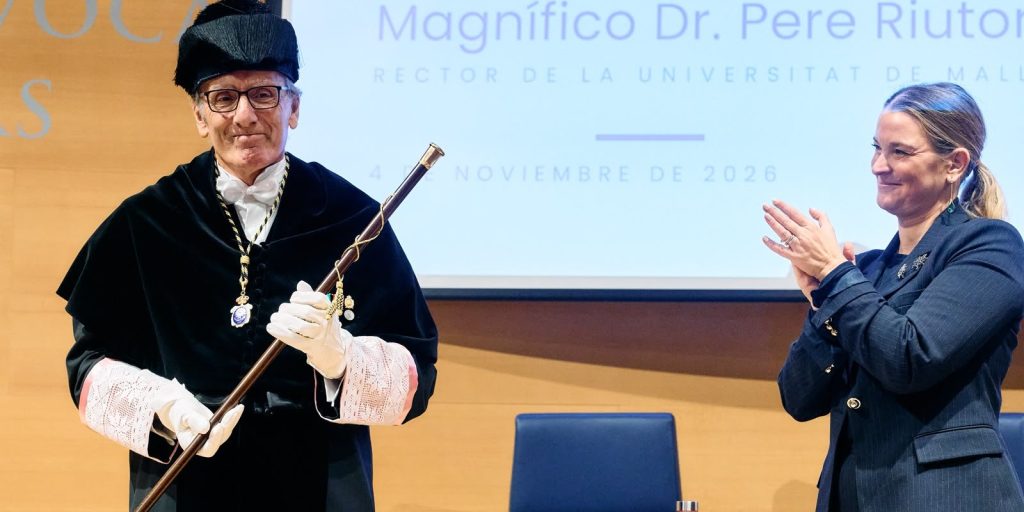
>> The president of the Government, Marga Prohens, participates in the investiture ceremony of the rector and his rector’s team, held at the Bar Association of the Balearic Islands >> The new rector advocates for a university committed to equal opportunity, access to higher education, and a scholarship system that will receive over 9 million euros in funding. See all images >> The president of the Governing Council, Diego González, stated: “Today we take a decisive step toward building a university created to offer new opportunities to our young people, foster research, and contribute to the progress of our society.” >> The President of the Government of the Balearic Islands, Marga Prohens: “Higher education is fundamental to the future of the Balearic Islands. We need universities capable of responding to the challenges of our region and training highly qualified professionals.” Dr. Pere Riutord Sbert took office this Wednesday as the first rector of the Universitat de Mallorca (UMAC-ADEMA) during an academic ceremony held at the headquarters of the Balearic Islands Bar Association in Palma, with the participation of the President of the Government of the Balearic Islands, Marga Prohens, and the President of the institution’s Governing Council, Diego González Carrasco. The inauguration marks a new step in the institutional development of the Universitat de Mallorca—an initiative promoted by ADEMA and recognized under Law 2/2026 of April 27, which establishes the legal framework for its academic and institutional development. In his inaugural address, delivered before academic and institutional authorities, representatives of civil society, members of the university community, and family members, Riutord identified university education, scientific research, innovation, and knowledge transfer as key pillars of his academic project, with the aim of contributing to the scientific, cultural, social, and economic development of the Balearic Islands. “I accept the honor of becoming the first rector of the University of Mallorca, with a commitment to help build an enduring university—one that serves our society and meets the expectations of future generations,” he stated. The rector highlighted the institution’s connection to the reality of the island, its dedication to expanding higher education opportunities, and its European and international outlook. “Our university aims to ensure that no young person’s educational opportunities are diminished by the place where they were born or reside,” he stated. In this vein, he defined the institution’s mission as being “local in its commitment, Balearic in its responsibility, Mediterranean in its identity, European in its outlook, and international in its relations.” For his part, the president of the Governing Council of the University of Mallorca, Diego González, welcomed the inauguration of Pere Riutord as the institution’s first rector, noting that it marks “a very important day for our university and for all of us who have worked for years to make this project a reality.” González has extended his congratulations to the new rector and his team, wishing them every success in this new phase. “Today, we take a decisive step toward building a university founded with the mission of offering new opportunities to our young people, fostering research, and contributing to the progress of our society,” he noted. Meanwhile, the President of the Government of the Balearic Islands, Marga Prohens, has joined in congratulating the new rector and his team, highlighting the importance of collaboration between institutions and society to strengthen the islands’ university system. “Higher education is fundamental to the future of the Balearic Islands. We need universities capable of responding to the challenges of our region, training highly qualified professionals, and forging stronger ties between the academic world, the business sector, and society. The University of Mallorca has the opportunity to contribute to these goals through rigor, quality, and a commitment to our community,” she emphasized. Research, innovation, and knowledge transfer Furthermore, Dr. Riutord has championed collaboration across disciplines and fields of knowledge, with projects that connect the health sciences, art, architecture, engineering, technology, and the social sciences. Furthermore, Dr. Riutord has championed collaboration across disciplines and fields of knowledge, with projects that connect the health sciences, art, architecture, engineering, technology, and the social sciences. Research featured prominently in his remarks. The rector emphasized the importance of combining teaching activities with the generation of knowledge and its transfer to society. “We do not want to limit ourselves to transmitting the knowledge of the past; we aspire to question it, expand upon it, and help generate the knowledge of the future,” he stated. Furthermore, he explained that the university aims to promote research with outcomes that reach hospitals, businesses, and other sectors of society—contributing to the strengthening of the productive fabric, the attraction of talent, and the creation of professional opportunities. Furthermore, it has addressed the role of artificial intelligence, robotics, simulation, virtual and augmented reality, haptic technology, digital fabrication, and big data analytics in the transformation of teaching, research, and professional practice. In this context, it has proposed further strengthening the integration of new technologies into classrooms, laboratories, and research projects, alongside training that enables an understanding of their foundations, possibilities, and limitations, as well as their ethical and social implications. The rector has also highlighted the importance of collaborating with the productive sector and various areas within the public and private sectors to foster practical training for students, in accordance with the relevant agreements and authorizations. Students, at the heart of the university project Riutord has placed students at the heart of the academic project at the Universitat de Mallorca and has proposed an educational approach geared toward the development of scientific, professional, and human capabilities. Regarding access to university studies, it was noted that Law 2/2026 mandates that at least 5% of an institution’s total annual revenue be allocated to scholarships and study grants. In this regard, it was stated that the budget earmarked for this purpose will exceed 9 million euros. “A university must be demanding—because knowledge requires effort—but it must also be accessible, as talent can be found anywhere and in any social circumstance,” it was emphasized. Furthermore, he has highlighted the challenges
ADEMA’s Observatory for Oral Health and Nutritional Habits strengthens its preventive and research work in Mallorca, with over 9,500 schoolchildren participating.
>> The initiative, recognized by European, national, and regional institutions, brings together researchers, faculty, and students from ADEMA for activities focused on health education, prevention, and the promotion of oral and nutritional health among schoolchildren. >>Around 1,200 schoolchildren from Palma and the *Part Forana* (the rest of the island of Mallorca) will take part in the 2026/2027 edition, which begins today, featuring oral health screenings and workshops on prevention, healthy eating, and physical activity. Since 2018, more than 9,500 students—ranging from preschool to secondary education—across 85 public, state-subsidized, and private schools in Mallorca have participated in the “Healthy Smiles” (“Sonrisas Saludables”) program, an initiative of the ADEMA Observatory for Oral Health and Nutritional Habits. For the 2026/2027 academic year—a new edition of which began today—nearly 1,200 students from Palma and the rest of the island (the *Part Forana*) are expected to take part in activities focused on the prevention and promotion of oral health and healthy nutritional habits. This initiative—which has received awards from various institutions, including the Association for Dental Education in Europe (ADEE)—an organization that brings together all dental schools across Europe—the Spanish Society of Epidemiology and Oral Public Health (SESPO), and the Department of Health of the Government of the Balearic Islands, among others—combines scientific research, teaching, and direct engagement with the school-age population, with the goal of fostering healthy lifestyle habits from an early age and actively contributing to disease prevention. Furthermore, the ADEMA Observatory for Oral Health and Nutritional Habits also maintains a significant research program. Data collected over the years have served as the basis for two doctoral theses by ADEMA faculty members—Dr. Daniela Vallejos Rojas and Dr. Irene Coll—as well as for the publication of various scientific studies in specialized, internationally recognized journals. >>The Observatory’s research activity has led to the development of two doctoral theses, as well as the publication of various studies in specialized, internationally recognized journals, focusing on the oral health of schoolchildren in Mallorca. La investigación de la doctora Daniela Vallejos, realizada con más de 700 escolares de 28 centros educativos de Mallorca, ha identificado desigualdades en la salud bucodental infantil relacionadas con el entorno familiar, los hábitos alimentarios y el nivel educativo de los progenitores. Por su parte, la tesis de Irene Coll, basada en una muestra de 233 adolescentes, ha revelado que el 75,9% de los participantes presenta problemas en las encías y ha analizado su relación con el consumo de alimentos ultraprocesados. These studies provide new insights into the oral health of schoolchildren in Mallorca and help identify risk factors and vulnerable groups, with the aim of improving prevention strategies. Through this line of work, the ADEMA University School continues to strengthen its commitment to scientific research, innovation, and knowledge transfer, with the goal of applying the results of its studies toward disease prevention and health promotion. Multidisciplinary team and workshops Throughout this seven-year follow-up period, a multidisciplinary team from ADEMA—comprising faculty, researchers, and students from university degree programs in Dentistry and in Human Nutrition and Dietetics, as well as from vocational training programs in Dietetics and Oral Hygiene—has conducted practical workshops, awareness-raising sessions, and oral health screenings, all centered on a preventive and holistic approach to health. Para esta edición, que acaba de arrancar, está prevista la participación de cerca de 1.200 escolares de diferentes centros educativos de Mallorca, con 600 participaciones programadas durante el primer semestre y 575 para el segundo. Las actividades se diseñan y adaptan a las distintas etapas educativas, combinando talleres participativos, juegos didácticos, dinámicas interactivas y exploraciones bucodentales. A través de estas propuestas, los escolares adquieren conocimientos y herramientas para mejorar su higiene oral, adoptar hábitos alimentarios saludables y prevenir enfermedades desde edades tempranas. As the project coordinators, Dr. Carla Busquets and Dr. Cristina Martorell, have explained: “The excellent reception this program continues to receive among educational centers in Mallorca reflects the importance of establishing links between the university and the educational community. One of the key values of this initiative is that it allows our students to apply the knowledge acquired in the classroom to real-life situations, develop communication skills, and gain a greater sensitivity toward the health needs of the population. It is an enriching experience for both the schoolchildren and the future healthcare professionals, in which service-learning and cooperative work play a fundamental role.” For the 2026-2027 academic year, the Observatory plans to involve 11 educational institutions from various municipalities in Mallorca, including Palma, Llucmajor, Sineu, and Santanyí. Participating schools include CEIP Camilo José Cela, CEIP S’Algar, CEIP Tramuntana, and CEIP Son Verí Nou, as well as the state-subsidized private schools (centros concertados) Balmes, San José de la Montaña, and Sant Josep Obrer. Also joining the initiative are IES Sineu, IES Aurora Picornell, and IES Santanyí, thereby extending the scope of the project to a diverse range of educational communities. According to Dr. Cristina Martorell, “prevention and early detection are essential for avoiding oral health problems from childhood. Taking care of one’s oral health also means looking after one’s overall health; small, everyday habits—such as thorough brushing, using fluoride toothpaste, reducing sugar intake, and having regular check-ups—can make a significant difference to the present and future well-being of schoolchildren.” In this same vein, Dr. Carla Busquets, head of the Nutrition degree program, has emphasized that “a balanced diet from childhood is essential for preventing diseases and promoting good oral and general health. Promoting healthy habits and facilitating access to nutritional education—especially among the most vulnerable groups—is key to improving the health and well-being of the population.”
Straumann rewards the scientific talent of two ADEMA dentistry students and sends them to the ITI Congress Iberia 2026.

>> The award-winning projects focus on innovation, the personalization of treatments, and the improvement of clinical practice. >> Lucía Guardiola Zafra and Mateusz Pekacki were recognized for their scientific presentations during the recent International Week of Teaching and Research in Dentistry and will participate in the ITI Congress Iberia 2026 in Madrid on October 22 and 23. Lucía Guardiola Zafra and Mateusz Pekacki, Dentistry students at the ADEMA University School, have received Straumann’s Scientific Communication Awards for work presented during the recent 8th ADEMA Dental Week—an international event dedicated to teaching and research in dentistry. Through its partnership with ADEMA, Straumann—a global leader in implant dentistry solutions—reinforces its commitment to education and emerging talent, supporting the next generation of professionals and contributing to the future of dentistry. The two students will participate in the ITI Congress Iberia 2026, which will be held on October 22 and 23 in Madrid at the Riyadh Air Metropolitano Stadium, bringing together more than 400 professionals. The 8th Dental Week brought together students, faculty, researchers, and industry professionals for a scientific program that combined lectures, workshops, oral presentations, and poster sessions, with a special focus on innovation, research, and new clinical approaches in dentistry. Mateusz Pekacki received the Award for Scientific Communication – Oral Presentation for his participation in the oral presentation category. During the event, he presented the paper “Management of traumatic crown fracture in permanent maxillary incisors of a child with autism spectrum disorder: a case report,” developed in collaboration with María Florencia Leopardo, Anushiravan Maher Lavandero, Carla Larenas Olim, and Catalina Bennasar Verger. This report addresses the management of dental trauma in a pediatric patient with autism spectrum disorder, highlighting the need to tailor treatment to each patient’s specific characteristics. The case involved a progressive approach utilizing short, spaced-out appointments, desensitization strategies, positive reinforcement, visual aids, and techniques such as “Tell-Show-Do.” For her part, Lucía Guardiola Zafra received the Award for Scientific Communication – Poster Presentation. The student participated in various scientific projects during the meeting, including the poster “Laser-assisted frenectomy,” produced in collaboration with Marta Rubio Bujosa and María Motta Cánovas. This study analyzes the potential clinical advantages of laser-assisted frenectomy compared to conventional techniques. The scientific review points to potential benefits such as reduced intraoperative bleeding, less postoperative pain, a reduced need for sutures, and greater patient comfort, while also highlighting the need to further expand the available scientific evidence. Both Pekacki and Guardiola have expressed their satisfaction with this recognition, which serves as motivation to delve further into their research and seize new opportunities, such as participating in the ITI Congress Iberia. The awards recognize not only the quality of the work presented but also the students’ ability to communicate, argue, and defend scientific findings—competencies that are increasingly relevant in the training of future healthcare professionals. Dr. Pere Riutord, Vice-Dean of Dentistry at the ADEMA University School, has emphasized the importance of introducing scientific research at the university level. “We want our students to view research as an integral part of dental practice. It is not merely about acquiring clinical knowledge, but also about learning to formulate questions, seek out evidence, analyze it critically, and communicate results with rigor. Recognitions such as these demonstrate that our students are capable of rising to that challenge while still at university,” he stated. Riutord stated that the participation of both students in Madrid will make it possible to “build upon the work done during Dental Week and bring students closer to scientific and professional environments where they can discover new lines of work, share experiences, and connect with dental professionals.” Dental Week is conceived as a forum for academic and professional exchange aimed at promoting excellence in dental education, fostering collaboration among institutions, and consolidating a scientific culture linked to clinical practice.